Getting to Arashiyama
Three railway lines reach Arashiyama, and the most straightforward for wheelchair users is the Hankyu Arashiyama Line, which terminates at Arashiyama Station close to the main sights. Kyoto's subway does not extend this far west, but the Randen (Keifuku) tram is a short, scenic option from the Kyoto City Subway Karasuma Line at Nijo Station.
An accessible taxi is often the simplest choice if you want to arrive directly at the bamboo grove entrance or at Tenryu-ji's gates without navigating station exits and street-level routes. Tokyo's Universal Design taxis (UD taxis) carry wheelchair users with a ramp and a higher roofline; Kyoto has similar vehicles, and our guide to accessible taxis in Japan covers how to book one. Allow an extra ten to fifteen minutes for the ramp to be set up.
Our specialists advise arriving before 09:00 on a weekday if mobility is a concern. The bamboo grove lane is narrow enough that crowds make it uncomfortable for wheelchair users and slower walkers; a morning visit avoids the worst of this.
The bamboo grove
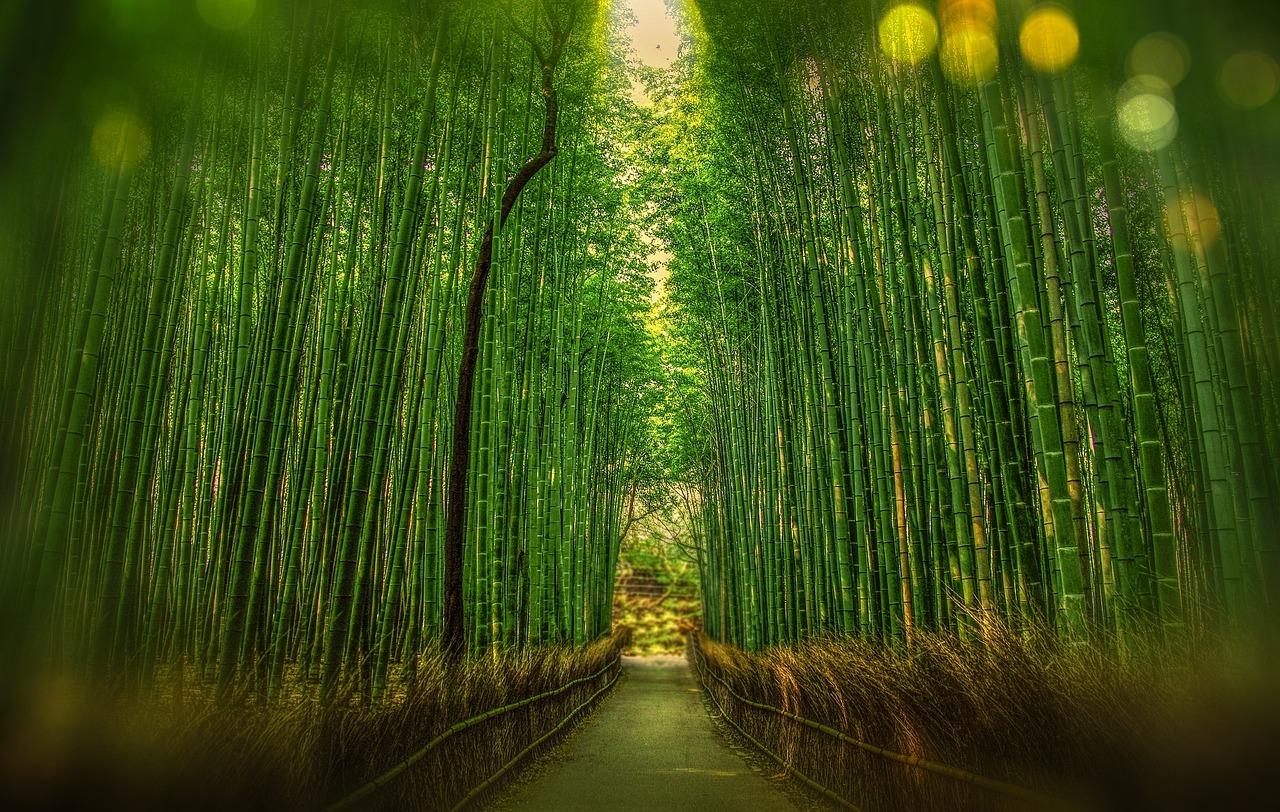
Kyoto's official universal tourism route describes the Arashiyama bamboo grove path as a long, gently sloping lane. The surface is firm enough for wheelchairs and walking frames, and the gradient is gentle rather than steep. This is one of the few iconic Japanese sights where the main experience — the tunnel of towering bamboo on either side — is accessible without a workaround or a separate route.
The path runs for several hundred metres from near Tenryu-ji's north gate to Nonomiya Shrine and the edge of the district's quieter streets. You walk one way through the grove; at the far end you can turn back or continue into the surrounding area. The main grove path runs as a continuous firm-surface lane from the Tenryu-ji north gate to Nonomiya Shrine without any steps or level changes, though the side lanes and temple approaches around it vary.
The grove is busiest on weekends and during cherry blossom season in late March and early April. Cherry blossom season is one of Japan's busiest travel periods generally, and popular viewing spots get crowded, especially at weekends. If you are visiting in spring and mobility is a concern, early morning on a weekday is the practical choice.
Tenryu-ji garden and beyond
Tenryu-ji's famous Sogenchi Teien garden sits behind the temple buildings and is laid out around a central pond. The main garden path is largely level, with gravel and stone surfaces that are manageable for most wheelchair users, though some sections are uneven and a companion's help may be useful on loose gravel. The garden entrance is close to the bamboo grove's southern end, so both can be visited on the same morning without covering much additional distance.
The Togetsukyo Bridge — the wide bridge over the Oi River that appears in almost every photograph of Arashiyama — is flat and wide enough for wheelchairs. The riverside area south of the bridge has level paths and benches where you can rest and watch the cormorant boats. This part of the district is easy to cover slowly and is a natural place to pause before heading back.
Nonomiya Shrine, reached via a short path near the bamboo grove exit, is flat at ground level and compact — worth the small detour if you have the energy.
Arashiyama with limited mobility
Arashiyama is one of Kyoto's most accessible districts for visitors with limited mobility. The bamboo grove path is long and gently sloping with a firm surface; Tenryu-ji's garden is largely level; and the Togetsukyo Bridge and riverside paths are flat and wide. An accessible taxi will drop you directly at the grove or the garden entrance.
The main practical points to watch are the width of the bamboo grove lane when it is busy (a reason to visit early on a weekday), the loose gravel on some sections of the garden path, and the fact that the side streets and temple approaches beyond the main sights vary in gradient and surface quality. We recommend staying on the main circuit — grove, garden, bridge — for the most comfortable visit.
If you need a wheelchair hired locally, our specialists advise booking in advance, as some suppliers in Japan ask for up to two weeks' notice. For the wider picture, see accessible holidays in Japan.
Combining Arashiyama with Kyoto's other sights
Arashiyama works well as a morning excursion from central Kyoto, leaving the afternoon for a sight closer to the city centre. Kinkaku-ji, the Golden Pavilion, is a natural companion: a gently sloping road leads in, and the path to the pavilion is over gravel on firm ground, with wheelchair users able to view the pavilion and rear garden. See our full guide to Kyoto in a wheelchair for the city's other accessible routes.
For visitors who also want to see Fushimi Inari, our guide to Fushimi Inari with limited mobility explains the ramp and lift access to the lower shrine and the torii tunnel, and is honest about which parts of the mountain walk are beyond a gentle pace.
The Japan Classic 14-day, the Japan Highlights 9-day and the Japan Grand Tour 18-day all include Kyoto with enough time to cover Arashiyama at a relaxed pace. Tell us your dates and we will price it for you.
Facts checked by our Japan team on 19 November 2026.
