Getting around by subway and train
Tokyo's subway network is extensive, and the good news for travellers with limited mobility is that almost every Tokyo subway station has a lift route from the street to the platform. The lift can sometimes be a walk from the main exit, so check the station map or the app before you go down — it is not always signposted from the ticket gates.
Tokyo's busiest times on the subway are roughly 07:30 to 09:30 and 17:00 to 19:30. Trains are very crowded during those windows, and the lifts are often in demand. Our specialists advise travelling outside rush hour whenever you can: mid-morning and early afternoon are noticeably calmer.
Public benches are uncommon in Tokyo, so cafés and convenience stores are the usual places to sit down and rest between sights. Build in stops rather than trying to do everything in one stretch.
If you are travelling on to other cities by Shinkansen bullet train, our guide to the Japan bullet train with a wheelchair explains how to book wheelchair spaces, arrange boarding help and check size limits in advance.
Taxis: Universal Design cabs and how to book them
Standard Japanese taxis are low-slung saloon cars. Most cannot carry passengers who use electric wheelchairs or larger manual chairs. If you use a wheelchair, you need a Universal Design (UD) taxi.
Tokyo's UD taxis have higher roofs, ramps, handrails and sliding doors, and they charge the same fares as ordinary taxis. Allow an extra 10 to 15 minutes for the driver to set up the ramp. In Tokyo's 23 wards, plus Musashino and Mitaka, you can book a UD taxi through the Uber Assist app; wheelchairs must be within 120 cm long, 130 cm high and 70 cm wide.
If you walk but find distances tiring, an ordinary taxi is fine: they are plentiful, air-conditioned and metered. Tell the driver your destination on a written card if language is a concern; hotel staff will write it for you.
Our fuller guide to accessible taxis in Japan covers booking options, size limits and what to expect outside central Tokyo.
Senso-ji, Meiji Jingu and other key sights
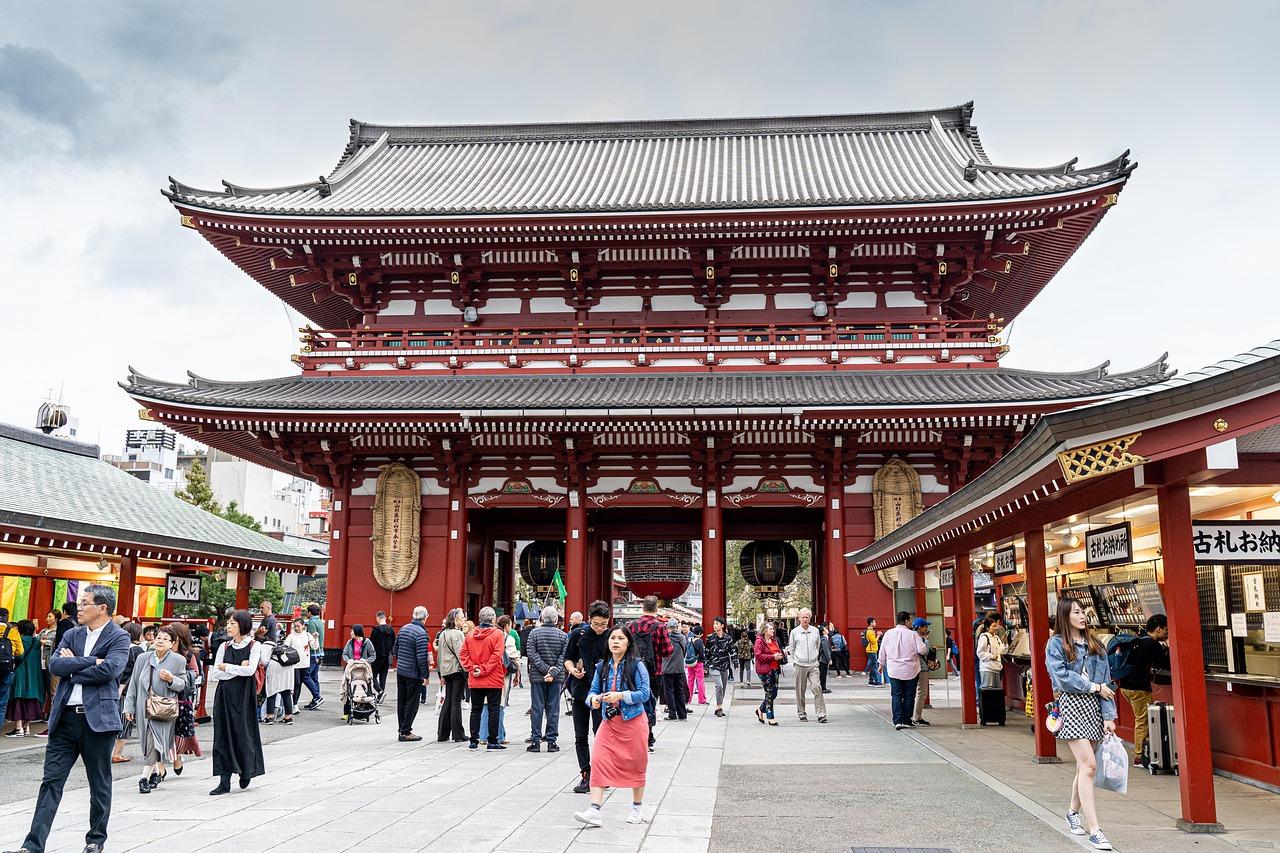
Senso-ji temple in Asakusa is Tokyo's most visited sight, and it has genuine access provision. The main hall has a lift built into its left side, clearly signposted with the wheelchair symbol, as well as a ramp. Some smaller halls, including Bentendo, have stairs only.
The shopping street leading to the temple, Nakamise-dori, is narrow and slow-moving, especially at weekends; the most crowded time of all is 1 to 15 January. If you use a wheelchair or find crowds tiring, go on a weekday morning. Note that at Asakusa station on the Ginza Line, the platform lift is on one side only, so wheelchair users may need to change direction at another station.
Meiji Jingu has a 700-metre approach path of fine gravel, with paved strips on either side that are easier for wheels and sticks. The gate and shrine building both have ramps. It is a gentle, forested walk with no steep gradients.
For more on accessible sights beyond Tokyo, our Japan over-70s accessibility guide covers the gentler pace across the whole country, and our Kyoto in a wheelchair guide covers that city in detail.
Airports: wheelchair loans and assistance
If you are flying into Narita Airport, wheelchairs can be borrowed free from any information counter in the passenger terminals. Arriving passengers can collect one once through passport control and customs.
At Haneda Airport, information counters rent wheelchairs that can be used right up to your seat on the plane, and staff can bring one to a chosen point in the terminal.
Airport assistance at UK airports is free; ask your airline about 48 hours before you fly. Gatwick's own criteria include travellers who cannot stand for a long time or walk long distances, so you do not need to use a wheelchair at home to qualify.
Tell us your mobility needs early and we will check the assistance arrangements for your specific flights and dates.
Tokyo with limited mobility
Tokyo is genuinely accessible for most travellers with limited mobility, but it rewards planning. Lift routes exist at every station, but are sometimes a walk from the exit — check station maps in advance. UD taxis bridge the gap when the subway feels too much. The main tourist sights — Senso-ji, Meiji Jingu, the Imperial Palace East Gardens — all have ramps or paved paths. Gardens by the Bay-style covered walkways do not exist here as they do in Singapore, but convenience stores are everywhere and always have seating.
Where Tokyo is harder: rush-hour trains are very crowded and lifts fill up; some older neighbourhoods have uneven paving; and attractions on hills, such as parts of Ueno, require care. Honest advice: one or two sights a day is a comfortable pace, with a taxi between them. For more on planning an accessible Japan holiday, visit our accessible holidays page.
Facts checked by our Japan team on 19 November 2026.
