Private hot spring baths: the gentler way in
The communal onsen is not your only option. Many hot spring inns offer private baths — called kashikiri — that you can reserve for your own group. You bathe alone or with your travel companion, without sharing the changing room or the bath with other guests.
Private baths can usually be booked in advance or at the front desk when you arrive, though they almost always cost a little extra. Book ahead where you can, especially in busy seasons.
If you use a walking frame or have difficulty with wet floors, a private setting also gives you more time and space to manage at your own pace. Ask whether the route to the private bath has steps, and how you get in and out of the bath itself.
Floor seating and the question of futons
Traditional Japanese meals at a ryokan are often served at a low table on a tatami floor, with cushions to sit on and a futon to sleep on. For anyone with bad knees, a bad back or hip problems, floor seating can be genuinely painful.
The good news is that more ryokan now offer Western-style rooms with beds, table-and-chair dining and, in some cases, a horigotatsu — a sunken floor table where your legs hang down rather than folding beneath you. The Japan Tourism Agency advises simply asking, and says some properties can supply Western tables and chairs even in traditionally styled rooms.
Some ryokan have been renovated to universal design principles, adding lifts, handrails, ramps and seating throughout. The Japan Tourism Agency advises telling the ryokan your needs beforehand; doing it in writing gives you a record.
Hot springs in Japan with limited mobility: an honest guide
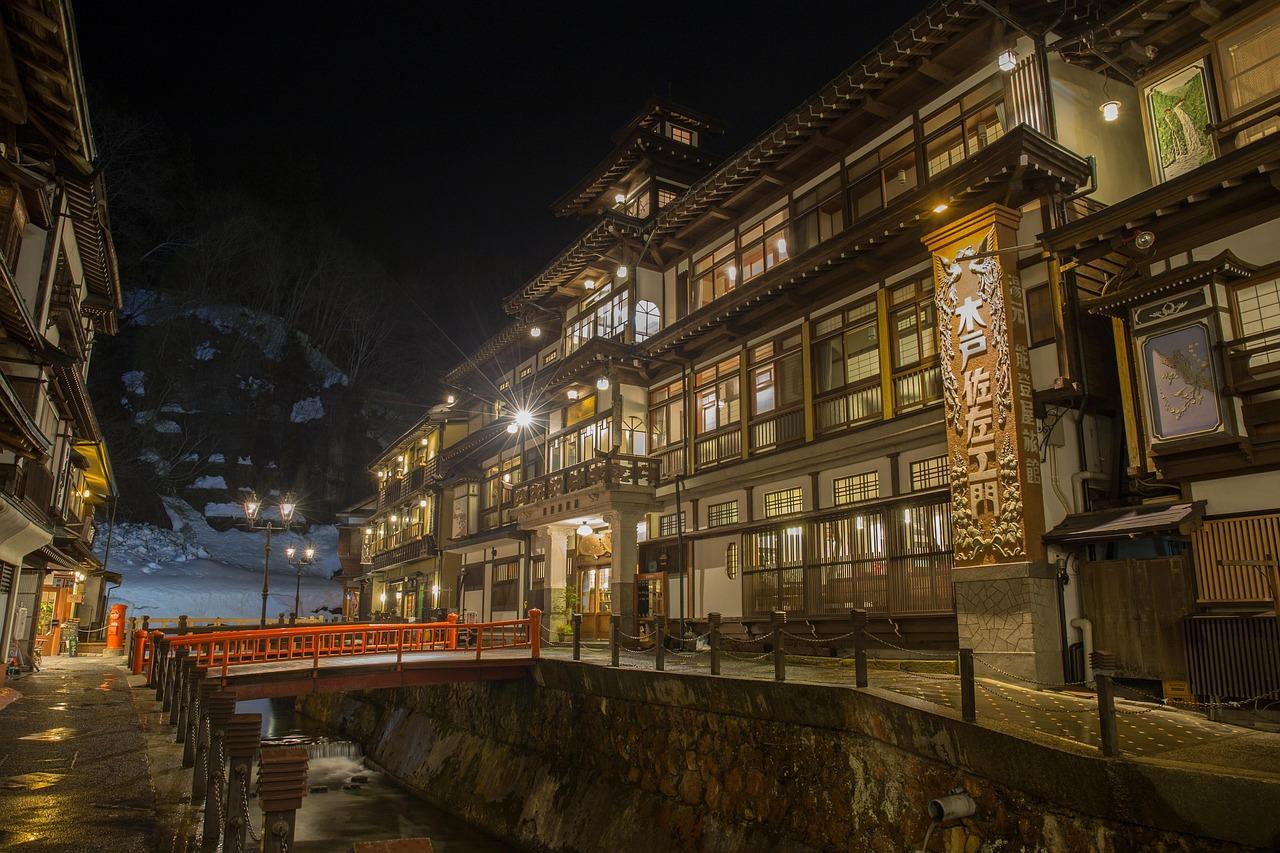
Onsen buildings vary enormously. Some are modern buildings; others are old wooden inns, where steps and low floor seating are more likely. Ask about the route from your room to the bath before you book.
Accessible bathrooms in Japanese hotels are less common than in the UK. Roll-in showers are rare; adapted bathrooms often have a floor drain beside the bath rather than a separate shower area. We recommend confirming the exact bathroom configuration directly with the property before you travel, and booking early because accessible or adapted rooms are limited.
The multipurpose toilets found at most stations and tourist sights are well equipped, but some lack a cistern or backrest to lean on, which can make rising from the seat harder. For the wider picture, see accessible holidays in Japan.
Getting to the onsen: travel considerations
Japan's most famous hot spring regions — Hakone, Beppu, Kinosaki and the Izu Peninsula — are served by trains and buses from the main cities. Hakone, for example, is reachable from Tokyo by train, and our Japan Classic 14-day itinerary includes time there.
For travellers with limited mobility, the journey to and from the onsen town matters as much as the bath itself. Many roads around Hakone are very steep, so straying from the usual round course of train, cable car, ropeway and boat can be hard going. Check how you will get from the station to the inn before you book.
Luggage forwarding — Japan's takkyubin service, run by Yamato — is worth using between hotels if you have a bad back or find heavy bags difficult. Hand your case over at the front desk in the morning and it is usually waiting at your next hotel the following day, so you travel light on the train. Keep your medication and a change of clothes with you. See our guide to Japan with bad knees for more practical tips on travelling comfortably.
What to ask before you book a ryokan
These are the questions our specialists advise raising before any ryokan stay if you have limited mobility: Does the property have a room with a Western bed? Is there a table and chairs for meals, or can they be provided? Is there a private bath, and can it be pre-booked? Are there steps between the entrance, the room and the bath? Is there a lift or ramp if the room is not on the ground floor?
Getting clear answers in writing avoids disappointment on arrival. The Japan Tourism Agency advises simply asking, and telling the inn your needs beforehand.
Our Japan over-70s accessibility guide covers the broader question of whether Japan suits older travellers, and our guide to Japan ryokan with limited mobility goes into further detail on adapted accommodation. Tell us your needs and we will check the details for your dates.
Video
Watch the short video
Facts checked by our Japan team on 20 November 2026.
